Dubai Metro Turns 17: The Milestones That Transformed How Dubai Moves
By Thasmiya
Seventeen years ago, at exactly **9:09:09pm on September 9, 2009**, Dubai launched a transport system that would fundamentally change how people moved around the city.
The **Dubai Metro** officially began operations with the opening of the Red Line, starting with 10 stations. What began as an ambitious infrastructure project has since developed into the backbone of Dubai’s public transport network.
Today, September 9, 2026, the Dubai Metro celebrates its **17th anniversary** after carrying billions of passengers and connecting residential, commercial, tourism and business districts across the emirate.
And the network is still growing.
With the **Blue Line under construction** and the newly approved **Gold Line** planned for 2032, Dubai is preparing for another major expansion of its rail network.
Here are some of the milestones that shaped the Dubai Metro.
## **2006: Construction of Dubai Metro Begins**
The story started before the first train ever appeared on Sheikh Zayed Road.
On **March 21, 2006**, His Highness Sheikh Mohammed bin Rashid Al Maktoum inaugurated construction of the Dubai Metro during an official ceremony at Madinat Jumeirah.
A few months later, on July 29, the first concrete pillar for the elevated Metro viaduct was constructed between the sixth and seventh interchanges on Sheikh Zayed Road.
It marked the beginning of one of Dubai’s most recognisable infrastructure projects.
## **2007: Tunnelling Begins Beneath Dubai**
On January 10, 2007, Sheikh Mohammed launched the main tunnelling works.
Construction began from Union Station towards Dubai Creek and continued towards BurJuman.
The underground sections represented a major engineering challenge, requiring tunnelling beneath some of the busiest and most developed parts of the city.
## **2008: Dubai Metro Takes Its First Test Run**
By September 2008, Dubai was ready to see its new transport system in action.
Sheikh Mohammed inaugurated the Metro’s technical trial operation on September 20, marking one of the final major steps before passengers could begin using the network.
## **09.09.09: Dubai Metro Officially Opens**
The date became one of the most memorable in Dubai’s infrastructure history.
At **9:09:09pm on September 9, 2009**, Sheikh Mohammed officially opened the Dubai Metro Red Line.
Commercial operations began with 10 stations.
The Metro also became the **first urban rail system in the GCC**, introducing a fully automated, driverless transport system to Dubai.
The response was immediate.
According to Gulf News’ anniversary report, more than **110,000 passengers used the Metro during its first 48 hours**, equivalent to nearly 10% of Dubai’s population at the time.
## **2011: The Green Line Opens**
Exactly two years after the Red Line launch, another major milestone arrived.
On **September 9, 2011**, the Dubai Metro Green Line officially began operations.
The Green Line significantly expanded Metro access through some of Dubai’s older and more densely populated districts, complementing the Red Line’s route through major commercial and business areas.
Together, the Red and Green lines established the foundation of the Metro network residents recognise today.
## **2016: Route 2020 Gets the Green Light**
As Dubai prepared to host Expo 2020, the Metro needed to expand again.
On June 29, 2016, Sheikh Mohammed approved the awarding of the **Route 2020** contract to extend the Red Line.
Sheikh Hamdan bin Mohammed bin Rashid Al Maktoum laid the project’s foundation stone on September 5, 2016.
The extension was designed to connect the existing Metro network with the Expo site and rapidly developing communities in southern Dubai.
## **2020: Route 2020 Officially Opens**
On July 8, 2020, Sheikh Mohammed inaugurated Route 2020.
The approximately 15km extension expanded the Red Line towards the Expo 2020 site, now Expo City Dubai, while improving connectivity for surrounding residential communities.
It became another important chapter in Dubai Metro’s expansion beyond its original network.
## **Dubai Metro Has Carried Nearly 2.8 Billion Passengers**
Perhaps the clearest indication of the Metro’s impact is the number of people who use it.
According to Dubai’s Roads and Transport Authority, the network carried **nearly 2.8 billion passengers between its launch in September 2009 and the end of 2025**.
In **2025 alone, around 295 million passengers** used Dubai Metro, representing an increase of approximately 7% compared with 2024.
Average daily Metro ridership is now around **one million passengers**.
The Metro accounts for approximately **40% of Dubai’s total public transport ridership**, according to RTA.
## **Dubai Metro Remains the City’s Most Popular Public Transport Option**
The numbers have continued growing in 2026.
During the **first half of 2026**, Dubai Metro carried approximately **136.5 million passengers**, according to figures reported as part of RTA’s latest public transport statistics.
Dubai’s wider public transport, shared mobility and taxi network recorded around **348.1 million passenger journeys**during the same six-month period.
It shows just how central the Metro has become to everyday life in Dubai.
## **A Driverless Network That Became a Dubai Landmark**
The Metro is not simply a transport network.
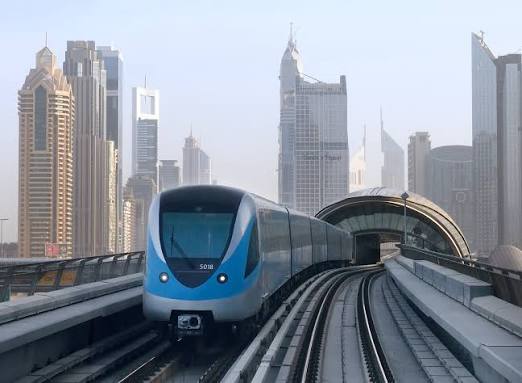
Its elevated tracks running alongside Sheikh Zayed Road, distinctive stations and driverless trains have become part of Dubai’s visual identity.
Station architecture was designed around themes inspired by the natural elements of **earth, water, fire and air**, while elements of the exterior architecture reference Dubai’s maritime and pearl-diving heritage.
The system is also designed around automated operations.
Train movements and network systems are managed through sophisticated Operations Control Centres, allowing the driverless network to operate while thousands of cameras monitor trains, stations and tunnels.
## **The Blue Line Is Dubai Metro’s Next Major Expansion**
The next chapter is already under construction.
The **Dubai Metro Blue Line** will span approximately **30 kilometres** and include **14 stations**.
It will serve nine major districts projected to have a combined population of around one million under the Dubai 2040 Urban Master Plan.
The route includes approximately 15.5km underground and 14.5km above ground.
It will also feature Dubai Metro’s first bridge crossing Dubai Creek, stretching approximately **1.3km**.
Construction reached around **20% completion by May 2026**, with RTA targeting 30% completion by the end of the year.
The Blue Line is scheduled to officially open on another symbolic date:
**September 9, 2029 — exactly 20 years after the original Dubai Metro launch.**
## **Dubai Is Also Building the Gold Line**
The Metro’s expansion will not stop with the Blue Line.
In April 2026, Sheikh Mohammed approved the **Dubai Metro Gold Line**, involving an investment of approximately **AED 34 billion**.
The Gold Line will span **42 kilometres with 18 stations**, serving 15 strategic areas across Dubai.
It will also become **Dubai’s first fully underground Metro line**, running at depths reaching around 40 metres.
The project will connect with the existing Red and Green lines and integrate with Etihad Rail, strengthening connections between Dubai’s local transport network and the UAE’s national rail system.
The Gold Line is scheduled to open on **September 9, 2032**.
## **Dubai Metro Network Could Reach 162km**
Dubai’s Metro network is entering its biggest period of expansion since its original launch.
RTA says the network comprising the Red Line, Green Line, Route 2020 and the Blue Line under construction represents around **120km and 67 stations**.
Once the 42km Gold Line and its 18 stations are added, the Dubai Metro network is expected to reach approximately:
**162 kilometres of track**
**85 stations**
The Gold Line alone is expected to expand the Metro network by around 35%.
## **From 10 Stations to a Citywide Transport Backbone**
Dubai Metro began commercial operations with just **10 stations in 2009**.
Seventeen years later, it has carried billions of passengers, connected communities across the emirate and become one of the defining pieces of Dubai’s infrastructure.
Its importance is also set to grow as Dubai develops new residential districts and its population continues to increase.
The Blue Line will arrive in 2029.
The Gold Line is planned for 2032.
And if the Metro’s first 17 years are anything to go by, Dubai’s rail network will continue changing the way the city grows around it.
From that first journey at **9:09:09pm on 09.09.09** to around one million passengers on an average day, Dubai Metro has become much more than a way to get from one station to another.
It has become part of how Dubai moves.