UAE Tightens Rules on Digital Learning Tools in Government Schools
By Thasmiya
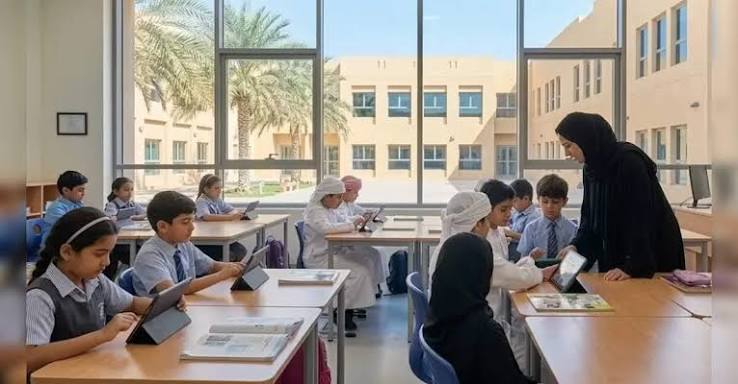
The UAE is changing how technology is used in government-school classrooms, with a new Ministry of Education initiative placing tighter controls on digital tools and electronic devices as part of the 2026–27 academic year reforms.
The move does **not mean technology is being banned from UAE schools altogether**. Instead, the Ministry is moving towards a more regulated model where digital tools are used selectively, while textbooks, handwriting, classroom discussion and face-to-face interaction play a stronger role in core learning.
## **Why is the UAE restricting digital learning tools?**
The change follows a Ministry of Education pilot involving around **2,500 students across nine government schools**.
Students were divided into groups to compare different levels of digital-tool use. The study examined academic achievement, basic skills, classroom concentration and discipline, as well as creative and higher-level thinking.
Preliminary findings showed stronger academic performance in less digitally intensive classrooms, particularly in **mathematics, science and Arabic**. Improvements in concentration and classroom behaviour were also reported.
## **The programme is expanding to 21,000 students**
Following the pilot, the Ministry is expanding the initiative to approximately **21,000 Grade 6 students across UAE government schools** during the 2026–27 academic year.
The goal is to establish a better balance between technology and traditional learning rather than eliminate digital education.
## **What changes for Grade 6 students?**
Under the new approach, core subjects are expected to rely more heavily on printed textbooks, notebooks, handwriting and direct classroom instruction.
Arabic, English, mathematics and science are among the subjects where traditional learning methods are being given greater emphasis.
Technology will continue to have an important role in subjects where it is directly relevant, including computer science and artificial intelligence.
## **Does this mean all digital tools are banned?**
No.
The headline can easily be misunderstood as a complete ban on digital learning. The Ministry’s announced initiative is better described as **regulating or restricting digital-tool use**, rather than banning all digital platforms.
Technology remains part of the UAE education system. The objective is to make sure devices support learning rather than replace fundamental skills such as reading, writing, communication, reasoning and independent thinking.
For that reason, schools, teachers and students should follow Ministry-approved systems and their school’s rules rather than introducing digital platforms or software independently.
## **What about AI tools?**
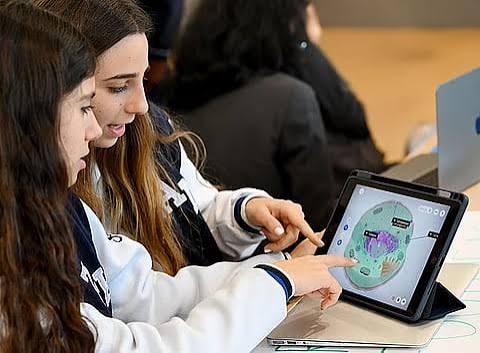
Artificial intelligence remains an important part of the UAE’s education strategy, but its use in schools is becoming more structured.
Earlier in 2026, reported Ministry guidelines placed restrictions around generative AI in schools, including age-based controls, teacher supervision for certain uses and restrictions during examinations. The framework also addressed privacy, academic integrity, deepfakes, copyright and unapproved platforms.
This means AI is not disappearing from classrooms. Instead, students are being encouraged to use it responsibly and in situations where it supports—not replaces—their own thinking.
## **Why handwriting and textbooks are coming back into focus**
Digital devices provide quick access to information and interactive learning, but constant screen use can also create distractions.
The Ministry’s pilot indicated that students in less digitally intensive classrooms showed improvements in concentration, time management and classroom discipline alongside academic performance.
The new approach therefore gives more room to handwriting, reading, classroom conversations and independent problem-solving.
## **Digital skills are still important**
The policy should not be interpreted as the UAE moving backwards on educational technology.
The UAE continues to invest heavily in AI, digital education and future skills. The difference is that technology is increasingly being treated as **one educational tool among many**, rather than something that needs to be present throughout every lesson.
The Ministry has said the initiative is intended to balance digital learning with academic, cognitive, behavioural and social development.
## **What does this mean for parents?**
Parents of students in government schools may notice children using physical textbooks and notebooks more frequently during the 2026–27 school year, particularly in Grade 6.
Families should also pay attention to instructions from their school regarding approved devices, platforms, apps and AI tools.
Parents should avoid assuming that a popular educational or AI app is automatically approved for classroom use simply because it is available online.
## **Is this for private schools too?**
The announced expansion of the digital-tool regulation project specifically covers **Grade 6 students in UAE government schools**.
Private schools operate under their relevant education authorities and individual policies, so the same Grade 6 arrangements should not automatically be assumed to apply to every private school in the UAE.
## **Part of wider UAE school reforms**
The digital-learning changes form part of broader reforms introduced for the 2026–27 academic year.
Other announced measures include changes to homework for younger pupils, assessment reforms, expansion of project-based learning and professional-development programmes for education staff.
Together, the changes are intended to strengthen learning outcomes while developing students’ academic, social and future-ready skills.
## **Why this matters**
The UAE is not abandoning digital education.
Instead, the latest changes signal a shift towards **more purposeful use of technology in the classroom**.
After a 2,500-student pilot indicated stronger academic performance and concentration under more controlled digital-learning conditions, the programme is now being expanded to around 21,000 Grade 6 students.
For parents and students, the message is simple: technology and AI remain part of UAE education, but they are expected to complement textbooks, handwriting, critical thinking and direct interaction—not replace them.
## **Source Credits**
Information source/resource owners: UAE Ministry of Education, Emirates 24|7, Education UAE and Al Bayan.
## **Image Credits**
For publication, use an official UAE Ministry of Education classroom or back-to-school image where available.
**Image credit/resource owner:** UAE Ministry of Education / relevant original publisher.