UAE Weather Update: Hail and Dusty Whirlwind Hit Masafi as Storms Sweep Sharjah and Eastern Areas
By Thasmiya
UAE Weather Update: Hail and Dusty Whirlwind Hit Masafi as Storms Sweep Sharjah and Eastern Areas
Parts of the UAE experienced sharply contrasting weather conditions on Tuesday, July 28, as heavy rain, hail and a dusty whirlwind affected Masafi and the eastern region while blowing dust reduced visibility in Dubai.
Convective clouds developed over the Hajar Mountains during the afternoon, producing intense localised downpours and strong winds. At the same time, much of Dubai and Abu Dhabi continued to experience hot summer conditions, highlighting how dramatically the weather can differ between the country’s mountainous east and its coastal cities.
## **What happened in Masafi?**
Heavy rain swept through Masafi, an area located near the border between Fujairah and Ras Al Khaimah.
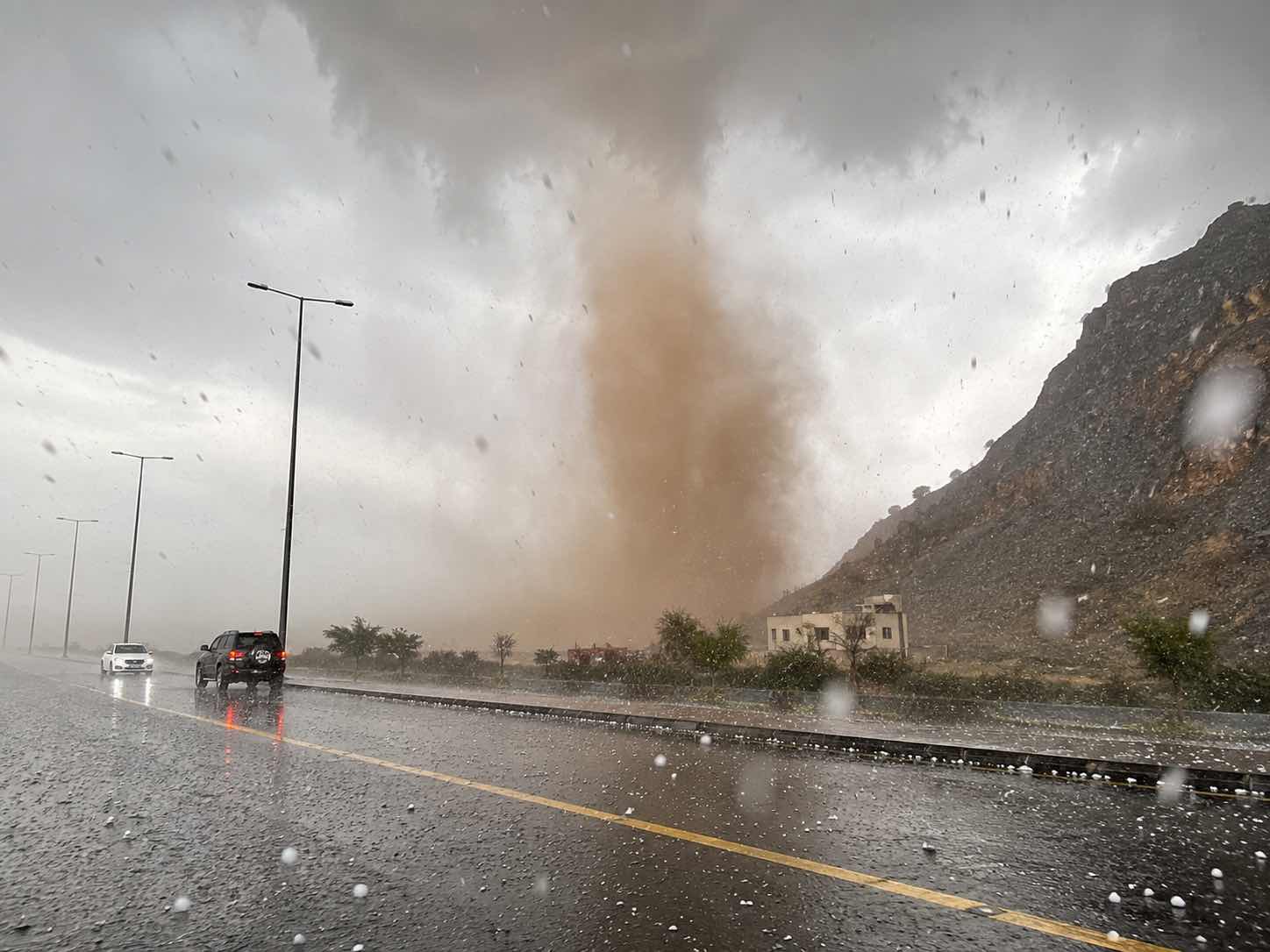
Videos shared from the region showed:

- Intense rainfall - Hail falling in and around Masafi - Water flowing through wadis - Strong winds lifting dust - A small dusty whirlwind forming during the storm
The National Centre of Meteorology reported hail over Masafi and Marbad in the eastern region as active convective clouds continued to develop over the mountains.
## **Dusty whirlwind spotted during the storm**
A dusty whirlwind was seen forming in Masafi as changing wind conditions accompanied the thunderstorms.
These rotating columns of dust can develop when strong surface heating creates rising air that begins to rotate. They are generally smaller and shorter-lived than tornadoes, although they can still lift sand, reduce visibility and move loose outdoor objects.
The Masafi event occurred alongside heavy rain and hail, reflecting the highly unstable local weather conditions affecting the eastern mountains.
## **Hail reported in the eastern region**
Hail was recorded in Masafi and nearby Marbad, close to the Hajar Mountains.
Hail forms inside powerful convective clouds when strong upward air currents carry water droplets into colder parts of the atmosphere. The droplets freeze and can grow as they move repeatedly through the cloud before falling to the ground.
Although the UAE is known for extreme summer heat, hail can still occur during strong thunderstorms because temperatures high inside the atmosphere are much colder than those at ground level.
The NCM warned that additional hail remained possible in areas affected by active convective clouds.
## **Heavy rain reaches parts of Sharjah**
Rainfall also affected parts of Sharjah and was forecast to extend into central areas of the emirate.
The intensity and distribution of the rain varied considerably, with some locations experiencing strong downpours while nearby areas remained dry.
This localised pattern is common during UAE summer storms, when clouds develop over particular mountainous or inland locations rather than moving evenly across the entire country.
## **Dust reduces visibility in Dubai**
While the heaviest rain remained concentrated in the east, dust was reported along Sheikh Zayed Road and other parts of Dubai.
Fresh to strong winds associated with the unstable conditions lifted sand and dust into the air, temporarily reducing visibility.
The NCM issued yellow dust alerts for several areas, warning that wind speeds could reach approximately 45 kilometres per hour across some eastern, western and inland locations.
## **Orange and yellow weather alerts issued**
Some areas were placed under an orange alert due to the risk of rain and hail, while yellow alerts warned of blowing dust and reduced visibility.
An orange alert indicates that hazardous conditions are expected and that residents should remain prepared and follow official guidance.
A yellow alert advises people to remain aware, particularly when travelling, working outdoors or participating in activities that could be affected by changing weather.
The alerts covered convective cloud activity, rainfall, hail, strong winds and blowing dust.
## **Why eastern UAE receives summer rain**
The Hajar Mountains play an important role in producing localised summer rainfall.
During the afternoon, intense sunshine heats the land and causes warm air to rise. When moisture is available, the rising air can form large convective clouds over the mountains.
These clouds may produce:
- Heavy but brief rain - Thunder and lightning - Hail - Strong downdraft winds - Blowing dust - Rapid temperature changes
This explains why Masafi and other eastern communities may experience storms while Dubai and Abu Dhabi remain mostly hot and sunny. The NCM had forecast convective cloud formation over eastern and southern areas during the afternoon.
## **Temperatures remain high despite the storms**
The rainfall did not signal an end to the UAE’s intense summer heat.
The country’s highest temperature on Tuesday reached **48.4°C in Al Faqa, Al Ain**, at 1:45pm local time.
For Wednesday, July 29, temperatures were forecast to reach approximately:
- **43°C in Abu Dhabi** - **42°C in Dubai** - **41°C in Sharjah**
The contrast between extreme heat and afternoon thunderstorms is typical of unstable summer weather in inland and mountainous areas.
## **More rain remains possible**
The NCM forecast fair to partly cloudy conditions across much of the UAE on Wednesday, with convective clouds expected to develop again over eastern and southern areas during the afternoon.
These clouds could bring scattered rainfall, particularly near mountainous and inland locations.
Winds were expected to remain light to moderate but could strengthen to around 40 kilometres per hour near convective clouds, raising additional dust and reducing visibility.
## **Motorists urged to drive carefully**
Drivers should take additional care during dust storms, heavy rain and rapidly changing visibility.
Recommended precautions include:
- Reducing speed gradually - Increasing the distance from the vehicle ahead - Avoiding sudden lane changes - Using headlights when visibility is poor - Keeping both hands on the steering wheel during strong winds - Avoiding flooded roads and flowing wadis - Not filming weather conditions while driving - Following police and NCM alerts
Abu Dhabi Police specifically urged motorists not to use mobile phones or record videos while driving in dusty conditions.
## **Residents warned to avoid wadis**
Heavy rain over mountains can cause water to flow rapidly through valleys and wadis, even when the rain falls several kilometres away.
Residents and visitors should avoid:
- Entering flooded valleys - Parking near drainage channels - Crossing moving water - Standing near mountain slopes - Camping in low-lying areas during storm alerts
Water levels can rise quickly, making apparently shallow crossings dangerous.
The NCM advised residents to remain away from locations vulnerable to flash flooding and water accumulation.
## **How to stay safe during hail**
Hail can damage vehicles, windows and unsecured outdoor property.
During a hailstorm:
- Move indoors or into a covered area - Park vehicles beneath suitable shelter where safe - Stay away from windows - Secure loose outdoor furniture - Avoid standing in open areas - Do not shelter beneath unstable trees or temporary structures - Follow instructions issued by local authorities
The NCM urged residents to monitor official forecasts and take the necessary precautions when hail is expected.
## **Health precautions during dusty weather**
Dust storms can aggravate asthma, allergies and other respiratory conditions.
The Ministry of Health and Prevention advised residents to:
- Remain indoors where possible - Keep windows and doors closed - Use a suitable mask and protective glasses outdoors - Keep vehicle air-conditioning vents closed to outside air - Use air purifiers or humidifiers indoors - Carry prescribed inhalers - Seek medical assistance for persistent coughing or breathing difficulty
Children, older people and those with respiratory conditions may be particularly sensitive to poor air quality.
## **Is a dusty whirlwind the same as a tornado?**
No. Although the two can appear similar, a dusty whirlwind or dust devil generally forms near the ground due to intense surface heating.
A tornado normally develops from a powerful thunderstorm and is connected to the cloud base.
Dust devils are usually smaller, weaker and shorter-lived, but they can still create hazards by lifting sand, dust and lightweight debris.
The exact classification of the Masafi event should be based on confirmation from meteorological authorities rather than social media videos alone.
## **Why this matters**
The latest weather conditions show how quickly the UAE’s summer climate can change from extreme heat to heavy rain, hail and blowing dust.
Residents may experience clear skies in one emirate while severe localised weather affects a nearby mountainous community. This makes official alerts especially important because conditions can vary significantly over short distances.
The main risks are not limited to rainfall. Sudden visibility loss, strong winds, hail and flowing wadis can all create dangerous conditions for motorists, outdoor workers and people visiting mountainous areas.
Residents should continue monitoring the National Centre of Meteorology and local authority channels before travelling to affected regions.
## **FAQs**
### **Where did hail fall in the UAE?**
Hail was reported in Masafi and Marbad in the eastern region near the Hajar Mountains.
### **Was there a tornado in Masafi?**
Reports described the event as a dusty whirlwind. There was no official confirmation in the cited reports that it was a tornado.
### **Did it rain in Dubai?**
The heaviest rainfall was reported in the eastern region and parts of Sharjah. Dubai mainly experienced hot weather and blowing dust, including reduced visibility around Sheikh Zayed Road.
### **Why was visibility low in Dubai?**
Strong winds lifted sand and dust into the air, temporarily reducing visibility across some roads and open areas.
### **Are more showers expected?**
The NCM forecast further convective cloud development and possible scattered rain over eastern and southern areas on July 29.
### **How hot did the UAE become?**
The highest temperature recorded on Tuesday was 48.4°C in Al Faqa, Al Ain.
### **What should drivers do during low visibility?**
Drivers should reduce speed, leave additional stopping distance, avoid abrupt movements and never use a phone to film while driving.
### **Where can residents check official weather alerts?**
Residents should follow the UAE National Centre of Meteorology and official police or government communication channels.
## **Source Credits**
Information source and resource owners: UAE National Centre of Meteorology, Ministry of Health and Prevention, Abu Dhabi Police, Gulf News and Khaleej Times.
## **Image Credits**
Image sources are combined from AI-generated visuals and other platforms. If any owner wants to be mentioned or any content needs to be changed, please email us at concerns@whatmatters.ae.