Venus and Jupiter Conjunction 2026: When UAE Residents Can See the Rare Planetary Pairing
By Mohammed
UAE skywatchers are in for a bright evening show as **Venus and Jupiter** appear close together in the western sky this June.
The two planets, often described as the brightest planets visible from Earth, will appear almost side by side shortly after sunset. The event is known as a **planetary conjunction**, where two celestial objects appear close together from our viewpoint on Earth, even though they are actually millions of kilometres apart in space.
According to Gulf News, the Venus-Jupiter conjunction will be visible across the UAE from **June 7 to June 9**, with the planets appearing close together in the western sky after sunset. Ibrahim Al Jarwan, Chairman of the Emirates Astronomical Society, said the planets should be visible to the naked eye under clear skies.
The closest approach is expected around **June 8 and June 9, 2026**.
International skywatching reports say Venus and Jupiter will appear around **1.5 to 1.6 degrees apart**, roughly the width of a little finger held at arm’s length. BBC Sky at Night Magazine says the planets will be at their closest on **June 9**, appearing low in the west just after sunset.
For UAE viewers, the best time to look is shortly after sunset, when the sky is dark enough for the planets to stand out but before they drop too low toward the horizon.
## Where should you look in the UAE sky?
Residents should look towards the **western or west-northwestern horizon** after sunset.
Venus will be the brighter of the two planets and will appear like a very bright “evening star.” Jupiter will look slightly dimmer but still clear and bright near Venus.
The planets will be low in the sky, so viewers should choose a location with an open view of the western horizon. Beaches, desert areas, rooftops, open parks and waterfront spots can offer better visibility than streets surrounded by tall buildings.
## Do you need a telescope?
No, the Venus-Jupiter conjunction should be visible to the naked eye.
Because Venus and Jupiter are both very bright, residents do not need a telescope to enjoy the event. However, binoculars can make the view clearer, especially if the sky is hazy or if viewers want to spot Mercury lower near the horizon.
Live Science says the planets will be easily visible without equipment, while binoculars or a telescope can make the view more impressive. A telescope may also allow experienced observers to see Jupiter’s largest moons.
## Why this conjunction is special
Venus and Jupiter conjunctions are popular because the planets are extremely bright.
Venus is usually the brightest planet in the sky, while Jupiter is often the second-brightest. When they appear close together after sunset, the pairing becomes one of the easiest astronomical events for casual skywatchers to notice.
Space.com describes the June 2026 event as part of a wider evening planet parade involving Venus, Jupiter and Mercury, with the closest Venus-Jupiter pairing happening on June 9.
## Can Mercury also be seen?
Mercury may also be visible lower near the horizon during the same period, but it will be harder to spot.
Mercury is much lower in the evening twilight and sets quickly, so viewers need a very clear western horizon and good timing. For most casual observers, Venus and Jupiter will be the main attraction.
The Planetary Society notes that Mercury is visible below Venus and Jupiter soon after sunset during June, but only with a clear view of the western horizon.
## Best places in the UAE to watch
For better viewing, residents should choose places with less obstruction and less light pollution.
Good options include open desert areas, beaches, waterfront promenades, rooftop viewing spots and large parks. Those outside dense city centres may get a clearer view, especially if the horizon is not blocked by towers.
Popular UAE skywatching areas such as Al Quaa in Abu Dhabi, Al Qudra in Dubai and open desert routes can offer darker skies, but viewers do not need to travel far because Venus and Jupiter are bright enough to be seen from many urban areas.
## Photography tips for the conjunction
The event can be photographed with a smartphone or camera.
For phone users, the best approach is to tap the bright planets on the screen, lower the exposure slightly and keep the phone steady. Using a tripod or placing the phone on a stable surface can improve results.
For camera users, a short exposure, low ISO and a tripod can help capture the planets without blurring. A skyline, beach, mosque, palm tree or desert foreground can make the image more visually interesting.
## Weather and visibility tips
Clear skies are important for the best view.
Dust, haze, clouds or humidity near the horizon can make the planets harder to see. Residents should check local weather updates from the [National Center of Meteorology](https://www.ncm.gov.ae/) before heading out.
Because the planets will be low in the sky, visibility can change quickly. It is better to arrive at the viewing location before sunset and start watching the western sky as twilight fades.
## Why this matters
The Venus-Jupiter conjunction is a simple but memorable sky event that anyone in the UAE can enjoy.
It does not require expensive equipment, advanced astronomy knowledge or travel to a remote location. Residents only need a clear western view after sunset.
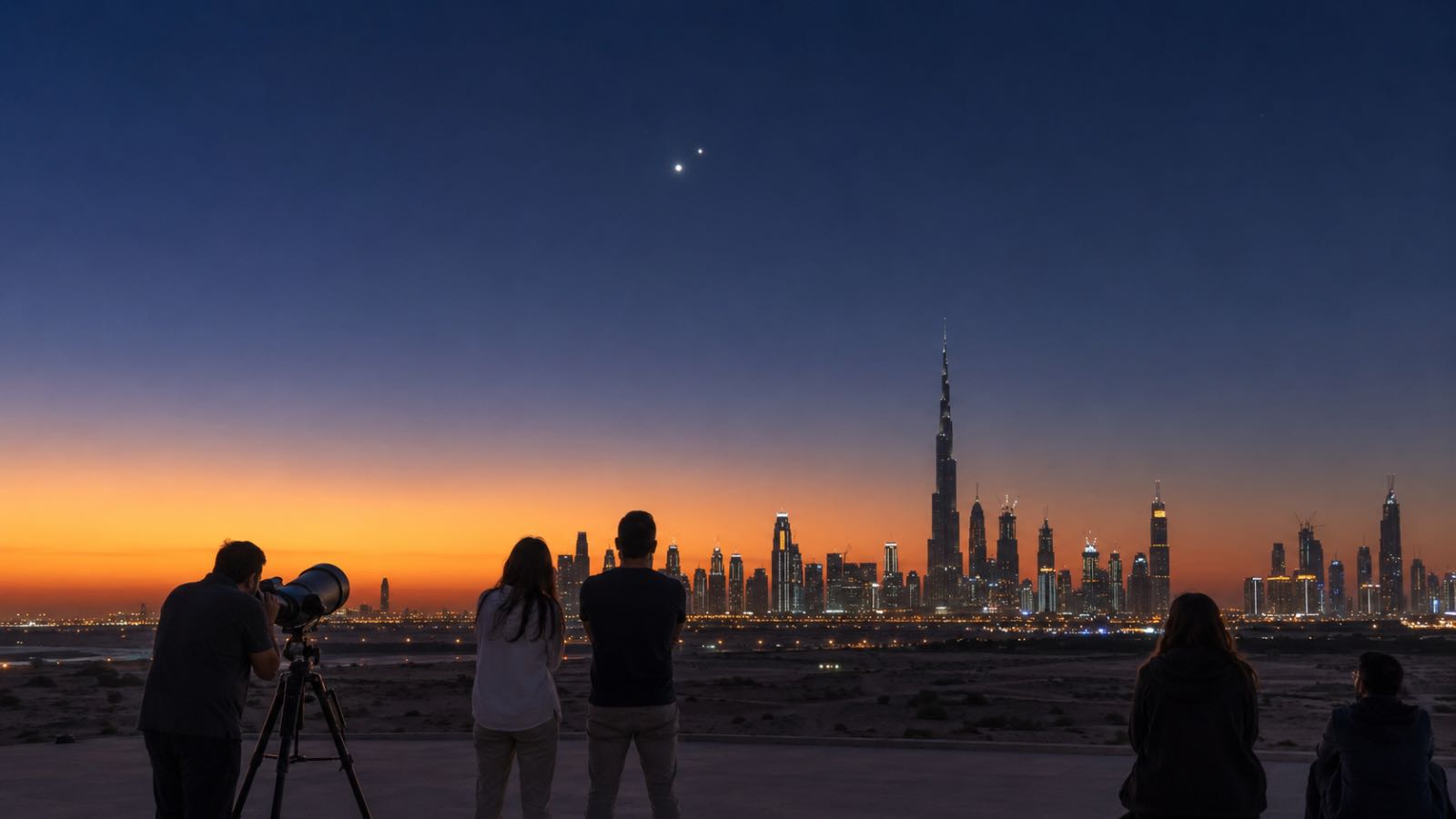
For families, photographers and astronomy fans, the rare evening pairing is a chance to pause, look up and witness two of the brightest planets appearing almost side by side above the UAE skyline.
## Source Credits
Information source/resource owners: Gulf News, Emirates Astronomical Society, BBC Sky at Night Magazine, Live Science, Space.com, The Planetary Society, National Center of Meteorology.
## Image Credits
Image credit/resource owners: BBC Sky at Night Magazine, Getty Images, Condé Nast Traveller Middle East, The National, EarthSky.