What Are the Most Common Reasons People Fail the Dubai RTA Road Test?
By Michelle
Passing the Dubai RTA road test is one of the final steps towards getting a UAE driving licence, but many learners do not succeed on their first attempt.
While the Roads and Transport Authority does not regularly publish detailed road-test pass rates, driving instructors commonly identify poor observation, weak lane discipline, hesitation and nervousness as major reasons candidates fail.
**1\. Not checking mirrors and blind spots**
One of the most common mistakes is failing to check mirrors and blind spots before:
- Changing lanes - Turning - Overtaking - Moving away from the roadside - Entering or leaving a parking space
Examiners expect these checks to be clear and consistent throughout the test. A quick glance is not enough if it does not demonstrate proper observation.
**2\. Poor lane discipline**
Candidates may lose marks for:
- Drifting between lanes - Selecting the wrong lane - Changing lanes too late - Crossing lane markings unnecessarily - Failing to stay centred within the lane
Good lane discipline shows that the driver is planning ahead and remaining aware of surrounding traffic.
**3\. Failing to give way**
Not yielding when required is considered a serious safety mistake.
This can include:
- Entering a roundabout without giving way - Pulling out unsafely from a side road - Ignoring vehicles with priority - Failing to stop for pedestrians where required - Entering traffic without enough space
A dangerous failure to give way may result in the test ending immediately.
**4\. Poor vehicle control**
Examiners assess how smoothly and safely candidates control the vehicle.
Common mistakes include:
- Harsh braking - Sudden acceleration - Poor steering control - Stalling a manual vehicle - Rolling backwards on a slope - Taking turns too quickly - Braking too late
The aim is to drive smoothly while remaining fully in control.
**5\. Ignoring road signs or entering restricted areas**
Major mistakes can include:
- Entering a no-entry road - Running a red light - Failing to stop at a stop sign - Stopping inside a yellow box junction - Ignoring directional signs - Exceeding the speed limit
These errors directly affect road safety and can lead to an immediate failure.
**6\. Driving too slowly or hesitating**
Many learners assume that driving very slowly will make them appear safer.
However, unnecessary hesitation can disrupt traffic and suggest that the driver is not confident enough to make safe decisions.
Examples include:
- Waiting too long to enter a roundabout - Refusing to change lanes despite having enough space - Driving far below the speed limit without a reason - Stopping unnecessarily - Delaying at junctions when it is safe to proceed
Candidates should be cautious, but they must also drive decisively.
**7\. Nervousness and lack of confidence**
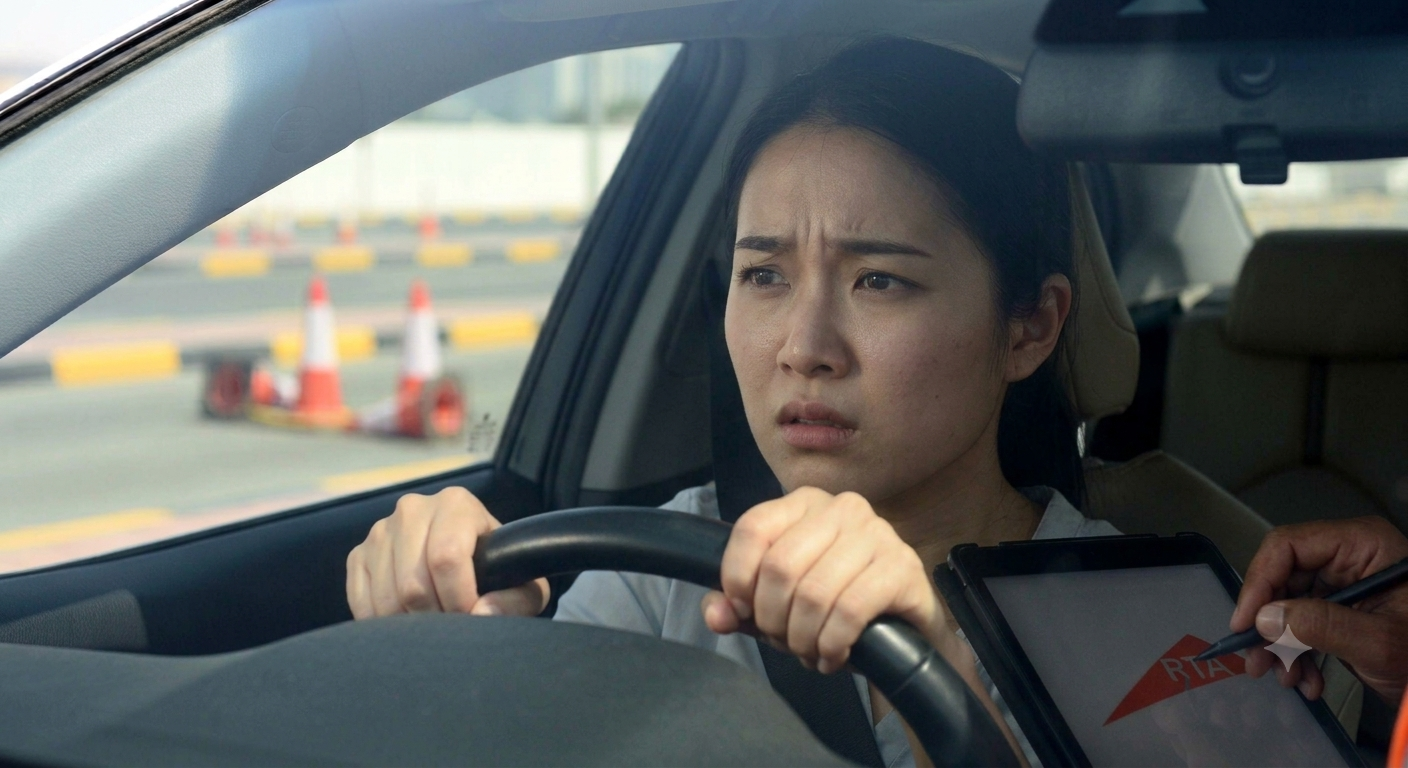
Some learners perform well during lessons but become anxious when the examiner enters the car.
Nervousness can lead to:
- Forgotten mirror checks - Sudden braking - Missed instructions - Poor judgement - Excessive hesitation - Unnecessary mistakes
Staying calm and treating the assessment like a normal driving lesson can help candidates perform more naturally.
**8\. Not maintaining a safe following distance**
Driving too close to the vehicle ahead reduces reaction time and can be considered unsafe.
Candidates should maintain enough distance to respond if the vehicle in front suddenly slows down or stops.
The appropriate distance may need to increase during heavy traffic, poor visibility or difficult weather conditions.
**9\. Not following the examiner’s instructions properly**
Candidates should listen carefully to the examiner’s directions.
When an instruction is unclear, it is safer to politely ask the examiner to repeat it rather than making a sudden or dangerous manoeuvre.
Missing a turn is generally less serious than cutting across lanes or braking sharply to follow an instruction at the last moment.
**10\. Forgetting indicators**
Failing to signal can confuse other road users and indicate poor awareness.
Indicators should be used before:
- Turning - Changing lanes - Leaving a roundabout - Pulling away - Moving towards the roadside
Candidates should also remember to cancel the indicator when necessary.
**Tips to improve your chances of passing**
Before taking the RTA road test:
- Practise mirror and blind-spot checks until they become automatic. - Plan lane changes early. - Follow road signs and speed limits. - Maintain a safe following distance. - Accelerate and brake smoothly. - Avoid unnecessary hesitation. - Listen carefully to the examiner. - Practise driving in different traffic conditions. - Get enough rest before the test. - Stay calm after making a small mistake.
One minor error does not always mean an automatic failure. Candidates should remain focused instead of assuming the test is already over.
**Pro tip: Act brave and look confident**
Act calm, brave and confident, as though driving is completely natural to you. Sit comfortably, make clear decisions and show the examiner that you are fully in control of the vehicle.
You should look like you can drive better than anyone else in the car—but through **safe, smooth and responsible driving**, not aggressive or overconfident behaviour.
Confidence can create a positive impression, but it must always be supported by proper observation, road awareness and respect for traffic rules.
**Why this matters**
The Dubai RTA road test is designed to confirm that new drivers can safely share the road with motorists, pedestrians, cyclists and other road users.
Understanding the most common reasons for failure can help learners prepare more effectively, avoid preventable mistakes and approach the test with greater confidence.
**FAQs**
**What is the most common reason people fail the Dubai RTA road test?**
Poor observation, especially failing to check mirrors and blind spots, is frequently identified as one of the most common mistakes.
**Can driving too slowly cause a failure?**
Yes. Driving significantly below the speed limit or hesitating unnecessarily can disrupt traffic and demonstrate a lack of confidence.
**Can one major mistake fail the road test?**
Yes. Serious safety violations such as running a red light, failing to give way or entering a no-entry road may result in an immediate failure.
**Does confidence matter during the test?**
Yes. Examiners expect candidates to make safe and confident decisions. However, confidence should never become carelessness or aggressive driving.
**Should I ask the examiner to repeat an instruction?**
Yes. Politely asking for clarification is safer than making a sudden or dangerous manoeuvre.
**Will one small mistake automatically fail me?**
Not necessarily. Candidates should continue driving calmly unless the examiner tells them the test has ended.
**Source Credits**
Information source/resource owners: Roads and Transport Authority, Emirates Driving Institute and Gulf News.
**Image Credits**
Image sources are combined from AI-generated visuals and other platforms. If any owner wants to be mentioned or any content needs to be changed, please email us at [**concerns@whatmatters.ae**](mailto:concerns@whatmatters.ae).