What Is Cloud Seeding in the UAE? How the Country Makes More Rain
By Eyad
Cloud seeding is one of the UAE’s most talked-about weather technologies, especially whenever rain appears in Dubai, Abu Dhabi, Sharjah or the Northern Emirates.
In simple terms, cloud seeding is a rain-enhancement technique used to encourage suitable clouds to produce more rainfall. It does not create clouds from nothing, and it cannot control storms. Instead, it works only when the right type of cloud is already present in the sky.
In the UAE, cloud seeding is carried out by the [National Center of Meteorology](https://www.ncm.gov.ae/) as part of the country’s long-term efforts to improve water security in an arid climate.
## What is cloud seeding?
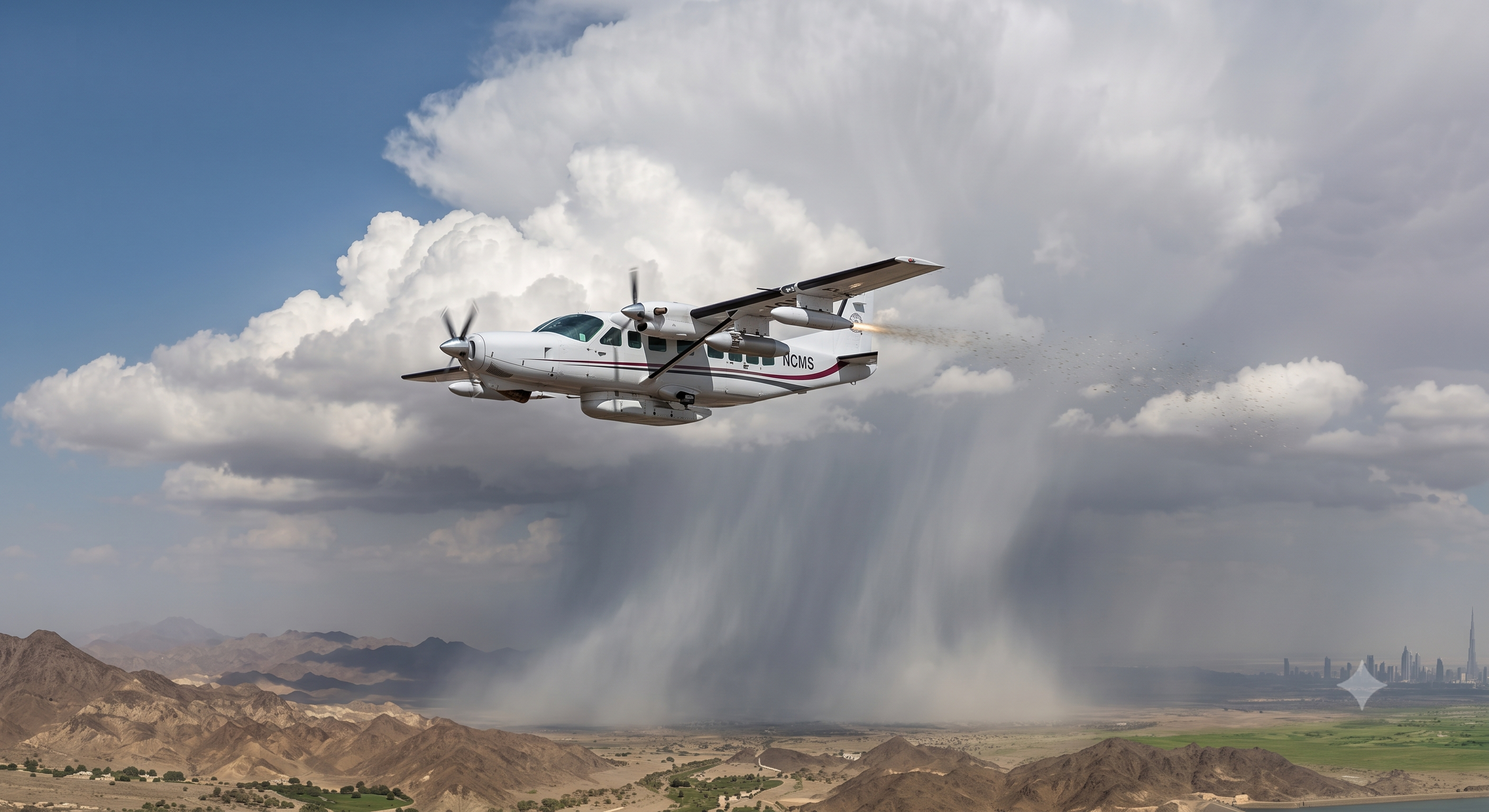
Cloud seeding is a weather-modification process that introduces tiny particles into suitable clouds to help water droplets form, grow and fall as rain.
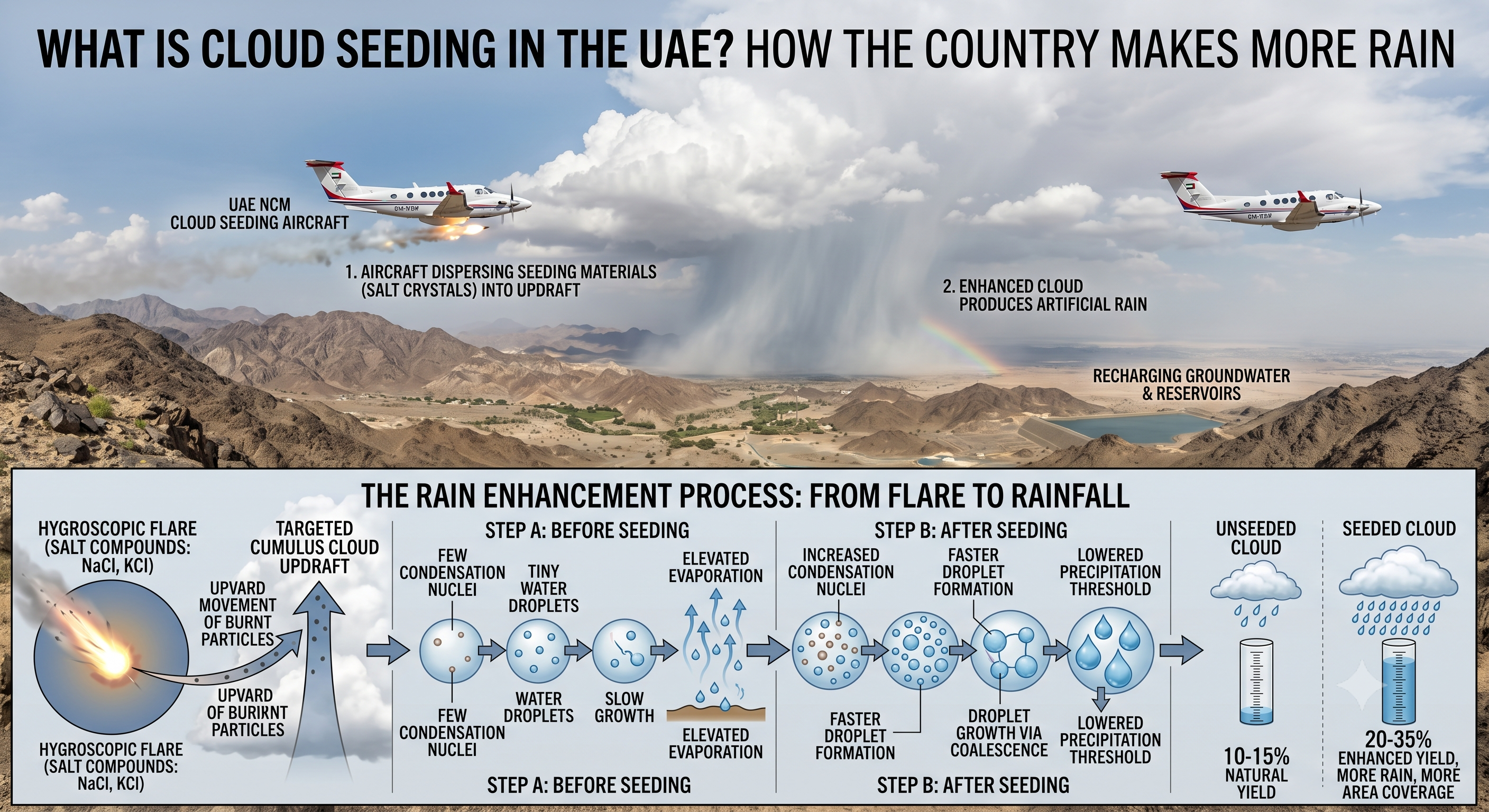
These particles act as condensation nuclei, giving moisture inside the cloud a surface to gather around.
When enough droplets become larger and heavier, they may fall from the cloud as rain.
The UAE usually uses hygroscopic cloud seeding, which means the seeding materials are designed to attract water. The materials used in the UAE include natural salts such as potassium chloride and sodium chloride.
## Why does the UAE use cloud seeding?
The UAE has a desert climate with limited natural rainfall.
Because water security is a major national priority, the country uses several methods to support its water needs, including desalination, groundwater management, treated wastewater reuse and rain enhancement.
Cloud seeding is not a replacement for these systems. It is one additional tool that can help increase rainfall from suitable clouds and support groundwater recharge over time.
The UAE’s rain enhancement work also supports scientific research into water security, climate adaptation and weather technology.
## How does cloud seeding work in the UAE?
Cloud seeding starts with weather monitoring.
Meteorologists at the National Center of Meteorology study satellite images, radar data, weather models and cloud development to identify suitable clouds.
When the right conditions appear, specialised aircraft are sent to seed selected clouds. The aircraft release cloud seeding flares containing water-attracting particles.
These particles help small droplets inside the cloud combine into larger droplets. If the cloud has enough moisture and suitable upward air movement, rainfall may increase.
## Can cloud seeding create rain anytime?
No. Cloud seeding cannot create rain from a clear sky.
It works only when suitable clouds already exist. The UAE mainly targets convective clouds that have enough vertical development and upward air currents.
If clouds are too weak, too dry or not suitable for seeding, the operation will not be effective.
This is why cloud seeding is not done on a fixed schedule. Operations depend on real-time weather conditions.
## Does cloud seeding control where rain falls?
No. Cloud seeding can help enhance rainfall from suitable clouds, but it cannot fully control where the rain will fall.
Clouds move with winds and natural weather systems. Even after seeding, one area may receive rain while another nearby area may stay dry.
This is why rainfall can vary widely between emirates, cities and neighbourhoods during the same weather event.
## Is every rainy day caused by cloud seeding?
No. Not every rainfall event in the UAE is caused by cloud seeding.
The country experiences natural weather systems, including low-pressure systems, convective clouds, winter rainfall and occasional thunderstorms.
Cloud seeding may be carried out when suitable clouds are present, but rain can also happen naturally without any seeding operation.
Residents should avoid assuming that every cloudy or rainy day is the result of cloud seeding.
## Did cloud seeding cause the UAE’s major floods?
Major floods and extreme storms should not automatically be blamed on cloud seeding.
Cloud seeding is designed to enhance rainfall from suitable clouds at an early stage. It is not used to create severe storms, and it is not considered capable of producing large-scale extreme weather events on its own.
During the record UAE rainfall event in April 2024, the National Center of Meteorology said it did not conduct cloud seeding operations before or during that severe weather episode.
Extreme rainfall is usually linked to larger atmospheric systems, moisture movement, pressure patterns and climate conditions rather than one aircraft operation.
## How long has the UAE been using cloud seeding?
The UAE has been involved in rain enhancement for decades.
The country’s rain enhancement operations began in the 1990s through cooperation with international scientific organisations. Over time, the UAE developed one of the region’s most advanced cloud seeding and rain enhancement programmes.
In 2015, the UAE launched the [UAE Research Program for Rain Enhancement Science](https://www.uaerep.ae/), managed by the National Center of Meteorology, to support global research in rain enhancement technologies.
## How many cloud seeding missions does the UAE carry out?
The number of missions changes depending on weather conditions.
In 2026, the National Center of Meteorology reportedly carried out around **80 cloud seeding missions** by late April, targeting suitable cloud formations as part of efforts to enhance rainfall and support water reserves.
Operations continue when suitable clouds are available and weather conditions allow safe, useful seeding.
## What technology does the UAE use?
The UAE uses aircraft, radars, weather stations, satellite data and forecasting models to support rain enhancement operations.
The country has also invested in research on advanced materials, artificial intelligence, drones, weather modelling and cloud microphysics.
The National Center of Meteorology has set up the **Emirates Weather Enhancement Factory**, which produces cloud seeding materials and flares in the UAE.
The factory has an estimated production capacity of **21,000 hygroscopic flares annually**, using environmentally friendly materials containing natural salts.
## Is cloud seeding safe?
The UAE says its cloud seeding materials are environmentally friendly and based on natural salts.
Rain enhancement operations are carried out under controlled meteorological conditions and are managed by specialised teams.
As with any weather technology, the UAE continues to invest in research to improve understanding, effectiveness and safety.
## Why cloud seeding matters for the UAE
Water is one of the UAE’s most important long-term challenges.
The country has limited natural freshwater resources, high temperatures and growing demand from cities, agriculture, industry and population growth.
Cloud seeding helps the UAE explore additional ways to improve rainfall and support water security. It also positions the country as a global contributor to rain enhancement science.
## What residents should understand
Cloud seeding is not artificial rain on demand.
It cannot make rain appear from a cloudless sky, stop storms, direct rain to one neighbourhood or guarantee rainfall every time aircraft fly.
It is a scientific method used to improve the chances of rainfall from suitable clouds.
For residents, the simplest explanation is this: cloud seeding may help clouds rain more, but the clouds and weather system must already be there.
## Why this matters
Cloud seeding is important because it shows how the UAE is using science and technology to respond to water scarcity.
The country’s programme combines aircraft operations, meteorology, research, local manufacturing and international scientific partnerships.
While the technology can support rainfall enhancement, it should not be misunderstood as a tool that creates instant rain or causes every storm.
For the UAE, cloud seeding is one part of a wider strategy to manage water resources, adapt to climate challenges and develop advanced weather science.
## Source Credits
Information source/resource owners: National Center of Meteorology, UAE Research Program for Rain Enhancement Science, World Meteorological Organization, Gulf News, The Guardian.
## Image Credits
Image credit/resource owners: National Center of Meteorology, UAE Research Program for Rain Enhancement Science, World Meteorological Organization, Gulf News, Getty Images.